
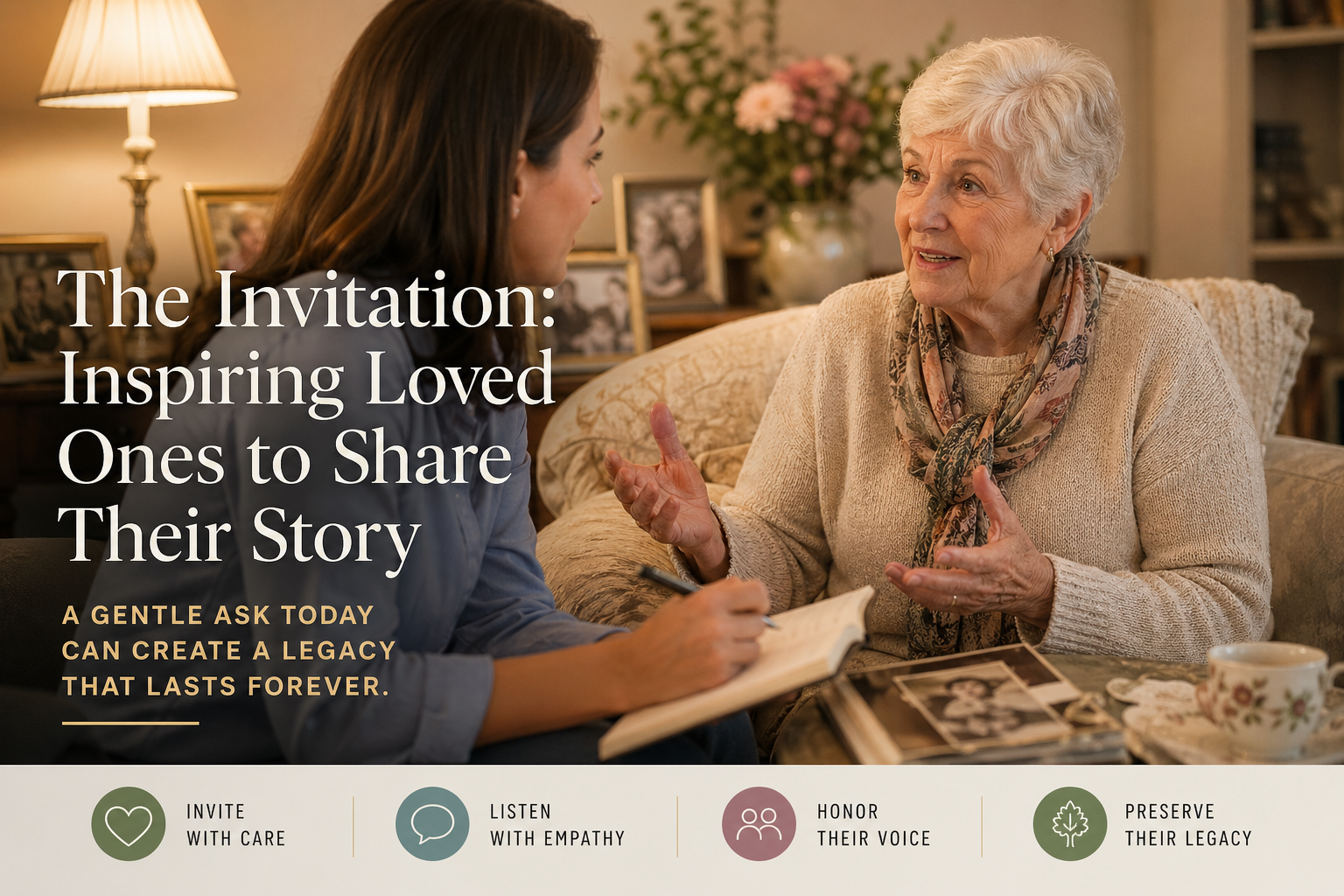
“A story is offered only when the invitation makes it feel safe to be told.”
There’s a quiet moment that often comes before a story is shared.
A pause.
A hesitation.
A question hanging gently in the air.
“Dad, I’ve been wondering what it was like for you growing up… If you’d ever feel comfortable sharing, I’d really like to understand that time in your life.”
Sometimes, that’s all it takes.
Not pressure. Not persuasion. Just an invitation—offered with care.
And suddenly, a door begins to open.
Why the “Ask” Matters More Than You Think
Asking a loved one to share their story can feel surprisingly daunting—for both of you.
They may hesitate for reasons you don’t immediately see:
- “My life isn’t that interesting.”
- “I don’t like being on camera.”
- “Some things are better left unsaid.”
- “What if I get emotional?”
Underneath these concerns are very human instincts: modesty, vulnerability, and the desire to feel safe.
That’s why the way you ask matters just as much as what you ask.
The goal isn’t to convince.
It’s to create a space where sharing feels natural, respected, and even joyful.
From Hesitation to Storytelling: What Actually Works
At Family Legacies, we’ve seen this transformation happen again and again.
One example is Etta, a family matriarch who initially refused to be filmed.
“My life isn’t that interesting,” she insisted.
Instead of pushing, I simply sat with her—no cameras, no film crew—over a cup of tea. I asked about small things: her childhood, her favorite recipes, the traditions she loved.
Slowly, her stories emerged.
A forgotten homework assignment tossed by her mother from a fourth-story window… straight into a passing garbage truck.
Her first train ride alone.
The day she met her husband—spotting his feet sticking out of a first-story apartment window, while he was absorbed in a book.
At first, she spoke softly. Then she laughed. Then she lit up.
By the time filming began, Etta had transformed into a vibrant storyteller—full of humor, warmth, and presence.
The Shift: From Pressure to Possibility
What makes the difference?
It’s the emotional environment you create.
Here’s how to do that:
- Start with Curiosity, Not Pressure
Instead of asking for “a full life story,” begin with something simple:
- “I’d love to hear about your childhood.”
- “What do you remember about the early days of your marriage?”
- “What are some of the moments that shaped you most?”
Curiosity opens doors. Pressure closes them.
- Make It Personal
Explain why their story matters—to you.
Not in general terms, but specifically:
- What you admire about them
- What you’ve learned from them
- What you hope future generations will understand
People are far more willing to share when they feel seen.
- Emphasize Joy, Not Performance
Many people worry they’ll have to “perform.”
Reframe the experience:
- It’s a conversation, not a production
- It can include laughter, memories, even playful reenactments
- It’s something you’ll do together
Storytelling should feel like connection, not pressure.
- Give Them Control
Let them decide:
- When and where to film
- What to share—and what to keep private
- Who will be present
- How the film will be used
When people feel in control, they relax.
When they relax, they open up.
- Start Small
You don’t need to begin with life’s biggest moments.
Sometimes, one simple question unlocks everything:
- “What’s a memory that still makes you laugh?”
- “What was your favorite meal growing up?”
- “Tell me about a time you got into trouble.”
One story leads to another. And another.
The Power of One Story
Josh, a family patriarch, initially brushed off the idea of being filmed.
“Future generations aren’t going to care about my stories,” he said.
So his family asked for just one story.
He shared a childhood prank.
The room erupted in laughter.
Something shifted.
That one story turned into many—and revealed not just what happened, but who he was: witty, warm, and deeply connected to his family.
What You’re Really Offering
When you invite someone to share their story, you’re offering more than a chance to talk.
You’re offering:
- A chance to be heard
- A chance to reflect
- A chance to be remembered
And perhaps most importantly—
A chance to continue shaping the lives of the people they love, long into the future.
Because what feels ordinary to them may be extraordinary to someone else.
A Gentle Invitation You Can Use
If you’re not sure where to begin, try something like this:
“I’ve been thinking about how much our family has grown, and how meaningful it would be to capture your stories. I’d love to hear about your life—whatever you feel comfortable sharing. We can take it one small story at a time.”
Simple. Respectful. Open.
The Takeaway
The most powerful stories are rarely extracted—they are invited.
And when that invitation is grounded in empathy, curiosity, and genuine love, something remarkable happens:
Hesitation softens.
Memories surface.
And a legacy begins to take shape.
Your Next Step
Think of one person in your family whose story matters.
Then ask yourself:
- What might be holding them back?
- How can I make this feel safe for them?
- What is one small, meaningful question I could ask today?
You don’t need the perfect words.
You just need the right intention.
Because sometimes, a single, thoughtful invitation is all it takes for a lifetime of stories to begin.
